Two different jobs that people often confuse
If you earn a salary, own a business, or have investments, at some point you'll probably deal with both a financial adviser and an accountant. Most people aren't entirely sure what the difference is, and that's understandable - there's genuine overlap in some areas. But they're trained differently, regulated differently, and do quite different things.
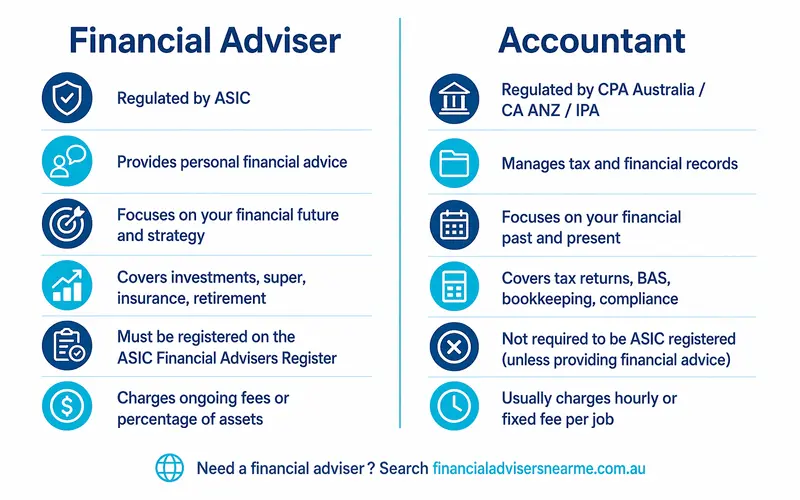
The short version: your accountant looks after your tax and financial records. Your financial adviser looks after your financial strategy. One is focused on the past and present, the other on the future.
What an accountant does
Accountants are trained in financial reporting, tax law and compliance. Their core job is to make sure your financial records are accurate, your tax obligations are met, and you're not paying more tax than you legally need to.
For individuals, that usually means preparing your annual tax return, advising on deductions, and flagging any tax issues you might have missed. For business owners, the scope is considerably broader - bookkeeping, BAS statements, payroll, financial statements, and advice on business structure.
Accountants in Australia are regulated by professional bodies like CPA Australia and the Institute of Chartered Accountants, and must hold a tax agent licence to prepare returns on your behalf. What they're generally not licensed to do is give you personal financial advice - recommendations about which superannuation fund to use, how to structure your investments, or whether you need life insurance. That requires an Australian Financial Services licence, which most accountants don't hold. You can read more about what an AFS licence covers in our guide: What is an AFS Licence?
There is an exception: accountants can provide a limited range of advice about SMSFs under a specific ASIC licence class. But outside of that narrow area, if your accountant is telling you which shares to buy or recommending a specific insurance policy, they may be operating outside their authorisations.
What a financial adviser does
Financial advisers are licensed under the Corporations Act to provide personal financial advice - recommendations tailored to your specific circumstances, goals and risk tolerance. They must hold an Australian Financial Services licence (or be authorised under one), complete an approved degree qualification, pass a professional exam, and do ongoing continuing professional development. You can learn more about adviser education requirements in our guide to FASEA Education Standards.
Their focus is on helping you build and protect wealth over time. That might involve advice on superannuation contributions and investment options, retirement planning, investment portfolios, life and income protection insurance, debt management, or estate planning. The key distinction is that they're giving you a personal recommendation, not just information - and they're legally required to act in your best interests when they do.
Every piece of personal financial advice must be documented in a Statement of Advice, which sets out the recommendation, the reasoning behind it, and any conflicts of interest the adviser has.
Where they overlap
Tax is the main area of overlap, and it can get confusing. Financial advisers can give advice that has tax implications - in fact, most good financial advice does. And some accountants have obtained an AFS licence so they can provide financial planning services as well as accounting services. In those cases, you're dealing with someone who can legitimately do both.
If you have an SMSF, you'll almost certainly need both. Your accountant handles the annual audit, financial statements and tax return for the fund. Your financial adviser - assuming they're licensed to advise on SMSFs - handles the investment strategy and ensures the fund is being run in accordance with your retirement goals and the superannuation rules.
Financial adviser vs accountant - a quick comparison
Although there's overlap, the two professions have very different legal responsibilities. The infographic below shows the simplest way to understand who does what.
Do you need both?
Not always. If your finances are relatively straightforward - you're employed, you have a standard super fund, you own your home and perhaps one investment property - you may only need an accountant. A competent accountant who knows your situation well can add considerable value without you needing a financial adviser on top.
Where a financial adviser becomes more clearly worthwhile is when your situation involves decisions with significant long-term consequences: approaching retirement and needing to think about how to draw down your super, receiving an inheritance, selling a business, or dealing with a complex insurance situation. These are decisions where personalised advice - not just tax compliance - matters a great deal. If you're unsure, our guide When Do You Need a Financial Adviser? explains the key signs - and once you've decided, our guide on how to choose a financial adviser covers what to look for.
How to check who you're dealing with
All financial advisers must be listed on the ASIC Financial Advisers Register. You can search the register using our directory, which sources its information directly from the ASIC Financial Advisers Register. This lets you confirm that the person you're dealing with is licensed to provide financial advice, review their qualifications and experience, and check whether there's any disciplinary history on record. Our guide on how to read an adviser profile explains what each section means. For more detail, see our guides on verifying ASIC registration and checking disciplinary history.
If you're looking for an adviser in a specific area, you can browse by state - New South Wales, Victoria, Queensland, South Australia, Western Australia and all other states and territories are covered.
For accountants, you can check their registration with the Tax Practitioners Board at www.tpb.gov.au, which maintains a register of all licensed tax agents and BAS agents in Australia.
The information on this page is general in nature and does not constitute financial advice. Your personal situation, objectives, or needs have not been considered. Before making any financial decisions, you should consider whether the information is appropriate for your circumstances and seek advice from a licensed financial adviser